
Elgeewrites - Words and beyond by Gayathri

There was a period when I was genuinely obsessed with James Clear’s website. When I read Atomic Habits, it perfectly articulated something I have built my entire career on: we do not rise to the level of our goals, we fall to the level of our systems.
As someone who builds systems for digital growth, the core message of this book is foundational to how I operate today. But not everyone has the time or desire to read a 400-page book to figure out how to be productive. The aim of this post is to bring you the exact essence of his framework so you can build better routines without the fluff. Let us get on with it, shall we?
(Disclaimer: This is just a book summary of Atomic Habits by James Clear to help other people who would not be able to read the entire book by themselves. These lines are taken from the book for academic purposes only. I am not posing as it is my work or my ideas. If you just want to grab a copy and build your own systems, Atomic Habits by James Clear).
Want to put this into practice today? I turned James Clear’s systems into an actual, usable tool. Grab my free Atomic Habits Google Sheet Tracker & PDF Summary Bundle to start tracking your daily progress without the guesswork.
I turned James Clear's systems into an actual, usable tool. Grab my free Atomic Habits Google Sheet Tracker & PDF Summary Bundle to start tracking your daily progress without the guesswork. Share on XAbout Atomic Habits by James Clear

Book Name: Atomic Habits : Tiny Changes, Remarkable Results, An Easy & Proven Way to Build Good Habits & Break Bad Ones
Author: James Clear
Genre: Fiction – Non Fiction, self-help
Summary of Atomic Habits
- The Fundamentals (Chapters 1 to 3)
- The 1st Law: Make It Obvious (Chapters 4 to 7)
- The 2nd Law: Make It Attractive (Chapters 8 to 10)
- The 3rd Law: Make It Easy (Chapters 11 to 14)
- The 4th Law: Make It Satisfying (Chapters 15 to 17)
- Advanced Tactics (Chapters 18 to 20)
The Fundamentals
Chapter 1: The Surprising Power of Atomic Habits
The core idea is the aggregation of marginal gains, searching for a tiny margin of improvement in everything you do. If you broke down everything you could think of and then improve it by 1 percent, you will get a significant increase when you put them all together. Getting 1 percent worse every day for one year takes you down to almost zero, while getting 1 percent better every day multiplies your results by 37 times.
Too often, we convince ourselves that massive success requires massive action. But habits are the compound interest of self-improvement. Clear also emphasizes that we must forget about goals and focus on systems instead.
Goals are about the results you want to achieve. Systems are about the processes that lead to those results. Winners and losers have the same goals, so that cannot be the reason for the winners. Fix the inputs and the outputs will fix themselves.
Chapter 2: How Your Habits Shape Your Identity
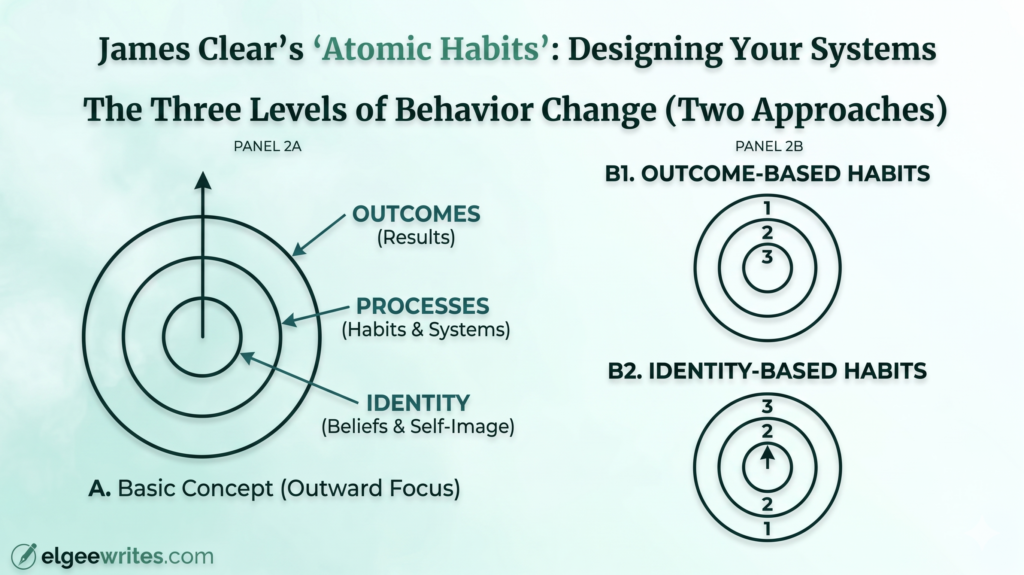
Changing our habits is challenging for two reasons: we try to change the wrong thing and we try to change our habits in the wrong way. There are three levels at which change can occur: changing your outcomes, changing your process, and changing your identity.
Your behaviors are usually a reflection of your identity. If nothing changes, nothing is going to change. The most practical way to change who you are is to change what you do. Each time you write a page, you are a writer. Each time you start a workout, you are an athlete. New identities require new evidence.
Chapter 3: How to Build Better Habits in 4 Simple Steps
A habit is a behavior that has been repeated enough times to become automatic. Every habit operates on an endless four-step feedback loop:
- Cue: Triggers your brain to initiate a behavior.
- Craving: What you crave is not the habit itself but the change in state it delivers.
- Response: The actual habit you perform.
- Reward: They satisfy us and they teach us.
If a behavior is insufficient in any of the four stages, it will not become a habit.
The 1st Law: Make It Obvious
Chapter 4: The Man Who Didn’t Look Right
You do not need to be aware of the cue for a habit to begin. We are so used to doing what we have always done that we do not stop to question whether it is the right thing to do at all. Until you make the unconscious conscious, it will direct your life and you will call it fate.
Chapter 5: The Best Way to Start a New Habit
People who make a specific plan for when and where are more likely to follow through. Identify a current habit you already do each day and then stack your new behavior on top. For example, after I finish eating dinner, I will put my plate directly into the dishwasher.
Chapter 6: Motivation Is Overrated
People often choose products not because of what they are, but because of where they are. Make sure the best choice is the most obvious one. If you want to drink more water, fill up a few water bottles each morning and place them on your table. It is easier to build new habits in a new environment because you are not fighting against old cues.
Chapter 7: The Secret to Self-Control
Disciplined people are better at structuring their lives in a way that does not require heroic willpower and self-control, because they spend less time in tempting situations. Self-control is a short-term strategy, not a long-term one.
The 2nd Law: Make It Attractive
Chapter 8: How to Make a Habit Irresistible
The more attractive an opportunity is, the more likely it is to become habit-forming. Dopamine surges during anticipation, not achieving the result. You can link an action you want to do with an action you need to do. After I get my morning coffee, I will say one thing I am grateful for that happened yesterday.
Chapter 9: The Role of Family and Friends
We do not choose our earliest habits, we imitate them. We copy habits from three different groups: the close, the many, and the powerful. Join a culture where your desired behavior is the normal behavior and you already have something in common with the group. If a behavior can get us approval, respect, and praise, we find it attractive.
Chapter 10: How to Find and Fix the Causes of Your Bad Habits
Make bad habits unattractive by reframing your habits to highlight their benefits rather than their drawbacks. Instead of saying you are nervous, tell yourself you are excited and getting an adrenaline rush to help you concentrate.
The 3rd Law: Make It Easy
Chapter 11: Walk Slowly, but Never Backward
If you want to master a habit, the key is to start with repetition, not perfection. Do not confuse motion with action. If I outline twenty ideas for articles I want to write, that is motion. If I actually sit down and write an article, that is action. Motion makes you feel like you are making progress without running the risk of failure.
Chapter 12: The Law of Least Effort
The less friction you face, the easier it is for your stronger self to emerge. Reduce the friction associated with good behaviors. If you want to draw more, put your pencils and notebooks within easy reach. Increase the friction associated with bad behaviors. Leave your phone in a different room until lunch.
Chapter 13: How to Stop Procrastinating by Using the Two-Minute Rule
When you start a new habit, it should take less than two minutes to do. Instead of trying to engineer a perfect habit from the start, do the easy thing on a more consistent basis. Standardize before you optimize.
Chapter 14: How to Make Good Habits Inevitable and Bad Habits Impossible
Success is less about making good habits easy and more about making bad habits hard. Automate your good choices so you do not have to rely on daily willpower.
The 4th Law: Make It Satisfying
Chapter 15: The Cardinal Rule of Behavior Change
Pleasure teaches your brain that a behavior is worth remembering and repeating. What is immediately rewarded is repeated. What is immediately punished is avoided. The consequences of bad habits are delayed while the rewards are immediate. You must select short-term rewards that reinforce your identity rather than ones that conflict with it.
Chapter 16: How to Stick with Good Habits Every Day
Use the Paper Clip Strategy, move a clip from one container to another as you finish the task. Never miss twice. When successful people fail, they rebound quickly. The problem is not slipping up, the problem is thinking that if you cannot do something perfectly, then you should not do it at all.
Chapter 17: How an Accountability Partner Can Change Everything
Even if you do not want to create a full-blown habit contract, simply having an accountability partner is useful.
Advanced Tactics
Chapter 18: The Truth About Talent
The secret to maximizing your odds of success is to choose the right field of competition. Genes do not determine your destiny, they determine your areas of opportunity. Build habits that work for your personality. When you cannot win by being better, you can win by being different. Our genes do not eliminate the need for hard work. They tell us what to work hard on.
Chapter 19: The Goldilocks Rule
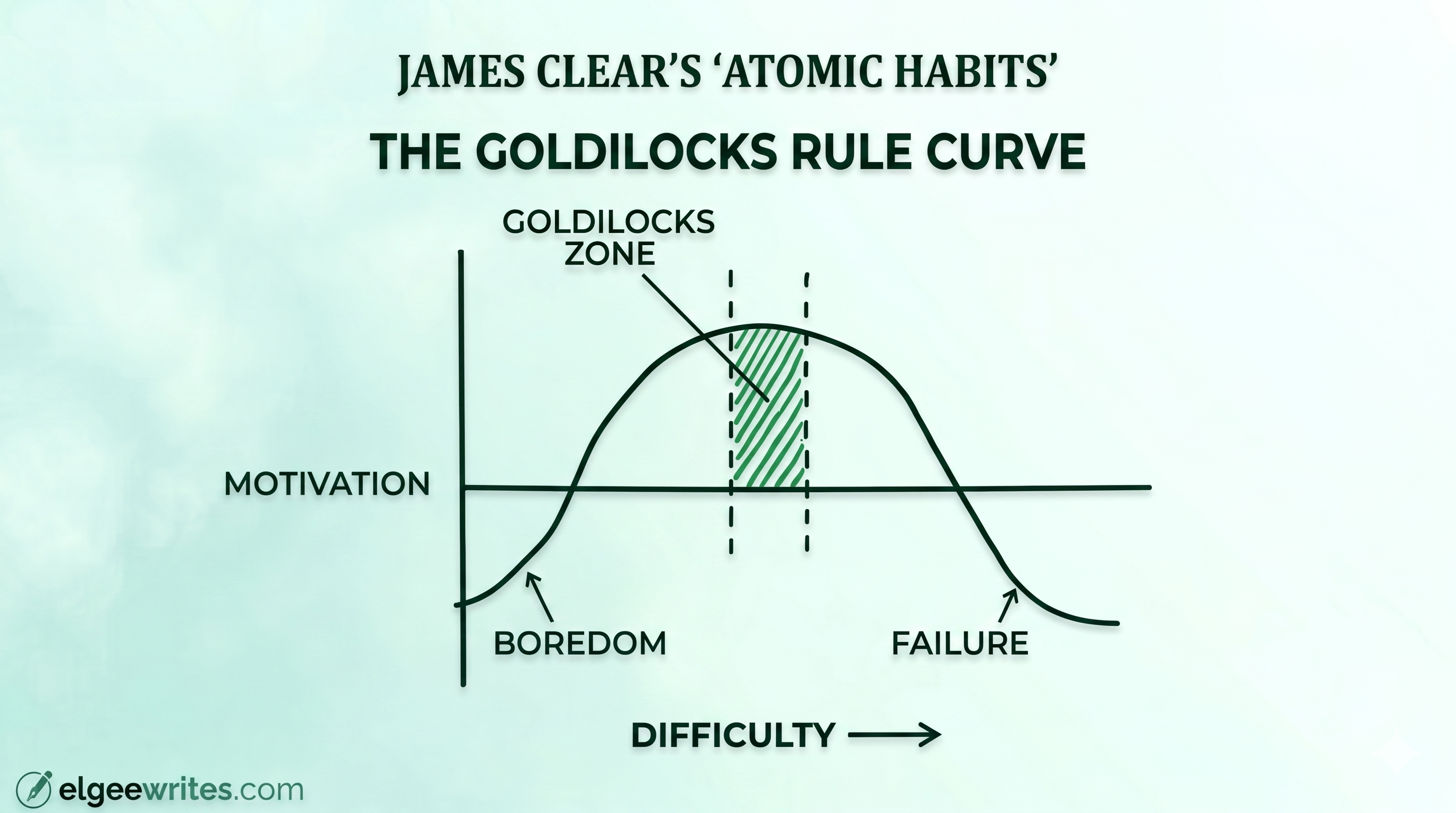
The Goldilocks Rule states that humans experience peak motivation when working on tasks that are right on the edge of their current abilities. Not too hard. Not too easy. Just right. Anyone can work hard when they feel motivated. It is the ability to keep going when work is not exciting that makes the difference. You have to fall in love with boredom.
Chapter 20: The Downside of Creating Good Habits
When you can do it good enough on autopilot, you stop thinking about how to do it better. Habits are necessary, but not sufficient for mastery. To avoid slipping into the trap of complacency, you must establish a system for reflection and review. A lack of self-awareness is poison. Reflection and review is the antidote.
Bottom-line
With a big enough why you can overcome any how. Your actions reveal how badly you want something. If you keep saying something is a priority but you never act on it, then you do not really want it. Grab your copy of Atomic Habits here!
Pin me!
Let us chat
Did you find my summary of Atomic Habits useful? Do you read summaries of books or would you rather read the entire book by yourself? What other non-fiction books should I be summarizing? Let us talk.
Your summary is appreciated! I love self-help books but I just need the meat of what they’re suggesting I do, not 21 chapters worth of explanation. My mind can’t deal!!! Just the bare bones that you gave us here is perfect. Thank you!
I am glad you found it useful, Jinjer!
Very interesting post.
Thank you
I like the idea of doing a book summary 🙂 Very interesting!
I am glad you enjoyed it, Megan!
Great review. I don’t think this would be a book for me, but thanks for showcasing it.
Thank you for dropping by!
I’m far too lazy for this and have no shame in confessing my habits are beyond nuclear intervention 😉
You are hilarious, DJ!
Thanks for the summary. I’m going to think about this one and forming some solid habits.
Oh that would be great!
This seems like a really interesting book.
It definitely was.
This is a great way to show what to expect from this book! Well done 🙂
Thank you!.
Absolutely useful for ppl like me 😉
Glad to be of use!
I don’t really read summaries of books but I think it works differently for nonfiction books, especially self-help books. I loved your summarized version of these chapters and am really looking forward to part two! 😀
I am glad you liked it, Charvi. I might be doing some more of non fiction books soon.